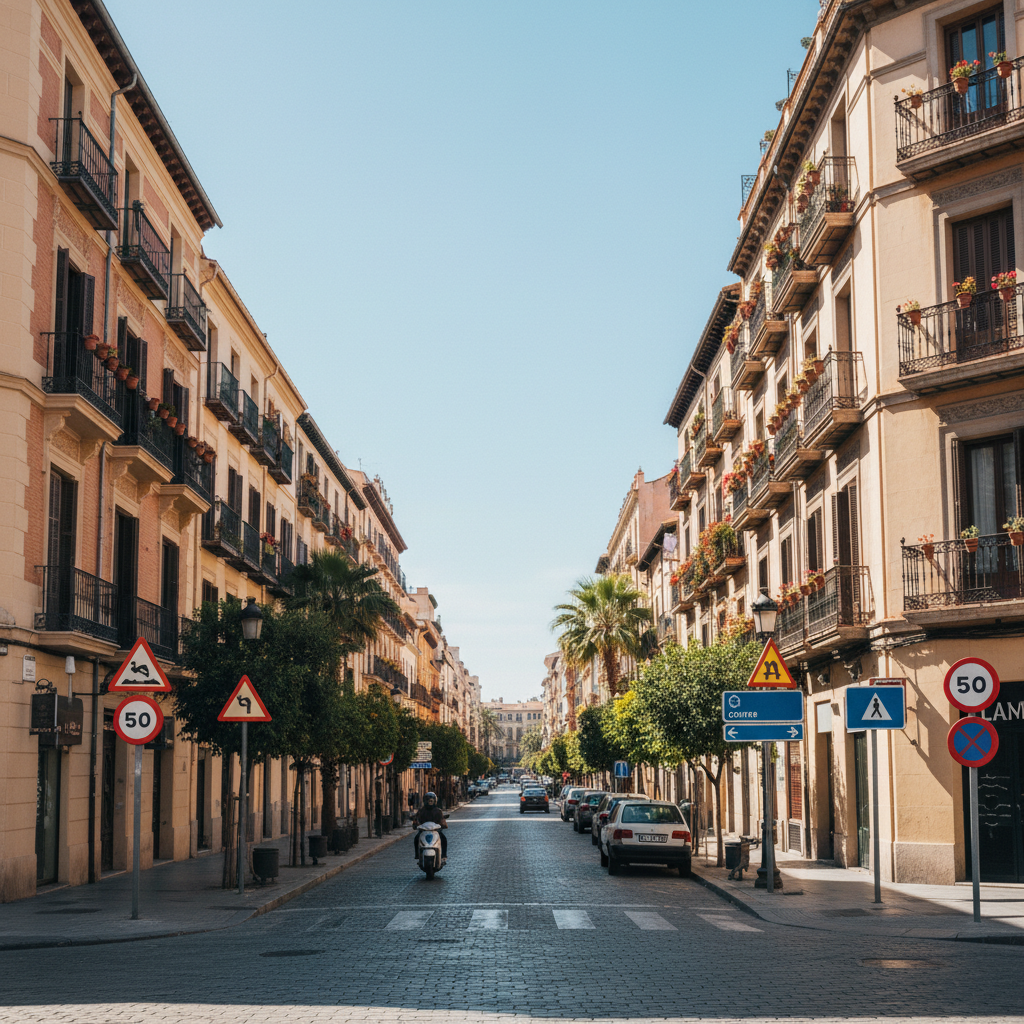
If there is one topic area that appears more frequently on the Spanish Permiso B theory exam than any other, it is traffic signs and signals. The DGT question bank is packed with questions that test your ability to recognize, interpret, and respond correctly to the signs you will encounter on Spanish roads. For expats who have driven in other countries, many signs will look familiar, but there are enough differences and Spain-specific signs to catch the unprepared off guard. Understanding the logic behind the sign system, rather than trying to memorize hundreds of individual signs, is the most efficient path to mastering this topic.
Spain uses the Vienna Convention on Road Signs and Signals as the foundation for its traffic sign system, which means the signs follow the same general European framework used across the continent. However, Spain has adopted additional signs and variations that are specific to its road network, climate, and traffic conditions. This guide will walk you through every major category of signs, highlight the ones most commonly tested on the Permiso B exam, and point out the signs that most frequently confuse English-speaking test-takers.
The Three Shape Categories: Circles, Triangles, and Rectangles
The single most important principle in understanding European traffic signs is that the shape tells you the purpose. Before you even read the content of a sign, its shape gives you critical information about whether it is giving you an order, warning you of a hazard, or providing information. Mastering this principle will allow you to correctly interpret signs you have never seen before, which is invaluable on the exam where you may encounter unfamiliar sign variations.
- Circular signs are regulatory. They give orders that you must obey. Red circles indicate prohibitions (things you must NOT do), while blue circles indicate obligations (things you MUST do)
- Triangular signs are warnings. They alert you to hazards or changes ahead. Warning signs have a white background with a red border and a black symbol
- Rectangular signs are informational. They provide guidance about directions, distances, facilities, and services. Blue rectangles are used on motorways, green on conventional roads, and white for local information
- Octagonal shape is reserved exclusively for the STOP sign, making it instantly recognizable from any angle
- Inverted triangular shape (yield/give way) is reserved for the priority sign, unique in its orientation
Exam tip: When you see a question about a circular sign with a red border, remember it is always a prohibition. If the circle is blue, it is always an obligation. This simple rule will help you eliminate wrong answers quickly even if you cannot remember the specific meaning of the symbol inside.
Regulatory Signs: Prohibitions and Obligations
Regulatory signs are the most legally significant category because they create binding rules for drivers. Violating a regulatory sign is a traffic infraction that can result in fines and point deductions. The DGT exam tests these signs extensively because understanding them is essential for safe driving in Spain. Let us break them into their two subcategories.
Prohibition Signs (Red Circle)
Prohibition signs have a white background, a red circular border, and a black or red symbol indicating what is forbidden. These are among the most commonly tested signs on the exam. The general prohibition sign is a white circle with a red border and no internal symbol, which means no vehicles may enter. When a red diagonal line crosses the symbol, it reinforces the prohibition. The end of a prohibition is indicated by the same sign with the red border replaced by a black border and diagonal black lines across the symbol.
- No entry (red circle with white horizontal bar): Prohibits all vehicles from entering. Often placed on one-way streets viewed from the wrong direction
- Speed limit signs (red circle with number): Sets the maximum speed for the road section. The end of a specific speed limit is marked by the same number in a white circle with black diagonal stripes
- No overtaking (red circle with two cars, one red): Prohibits overtaking motor vehicles other than two-wheeled motorcycles without sidecars
- No stopping (blue circle with red X): Prohibits stopping or parking at any time. The single red diagonal line version (no parking) allows stopping briefly but not parking
- No horn (red circle with horn symbol): Prohibits the use of audible warning devices except in cases of imminent danger
- No U-turn (red circle with U-turn arrow): Prohibits making a U-turn on that section of road
- Weight limit (red circle with tonnage): Prohibits vehicles exceeding the stated weight from using the road
- Height limit (red circle with height measurement): Prohibits vehicles exceeding the stated height, commonly seen before tunnels and bridges
Obligation Signs (Blue Circle)
Obligation signs are blue circles with white symbols. They tell you what you must do rather than what you must not do. These are less intuitive for many drivers because we tend to think of signs as restrictions. The most common obligation signs specify mandatory directions (turn right, turn left, go straight), minimum speed limits, mandatory use of snow chains, and mandatory lanes for specific vehicle types. A particularly important one for the exam is the mandatory direction at roundabout sign, which shows three white arrows in a circular pattern on a blue background.
- Mandatory direction arrows (blue circle with white arrow): You must proceed in the indicated direction. Straight, left, right, or combinations
- Roundabout (blue circle with three circular arrows): Indicates mandatory direction of travel around a roundabout, always counter-clockwise in Spain
- Minimum speed (blue circle with number): You must not travel slower than the indicated speed unless traffic conditions require it
- Snow chains mandatory (blue circle with chain symbol): You must fit snow chains to your driving wheels before proceeding
- Bicycle path (blue circle with bicycle): This lane or path is reserved exclusively for cyclists
- Pedestrian path (blue circle with pedestrian): This path is reserved for pedestrians only
Warning Signs: Hazards Ahead
Warning signs are triangular with a white background, red border, and black symbol. They alert you to potential hazards or changes in road conditions ahead, giving you time to adjust your speed and driving behavior. Warning signs do not create legal obligations in themselves, but ignoring the hazard they indicate could lead to an accident or an infraction if you fail to adjust your driving appropriately. The DGT exam frequently tests your understanding of what action to take when you see a specific warning sign.
Some of the most commonly tested warning signs include the curve warning signs (single curve, double curve, and series of curves), the intersection warnings (crossroads, T-junction, and roundabout ahead), and the condition-specific warnings (slippery road, falling rocks, strong crosswinds). Spain also has specific warning signs for level crossings (railway crossings) that include a series of countdown markers at 300 meters, 200 meters, and 100 meters before the crossing. Understanding these countdown markers and the appropriate response at each stage is a frequent exam topic.
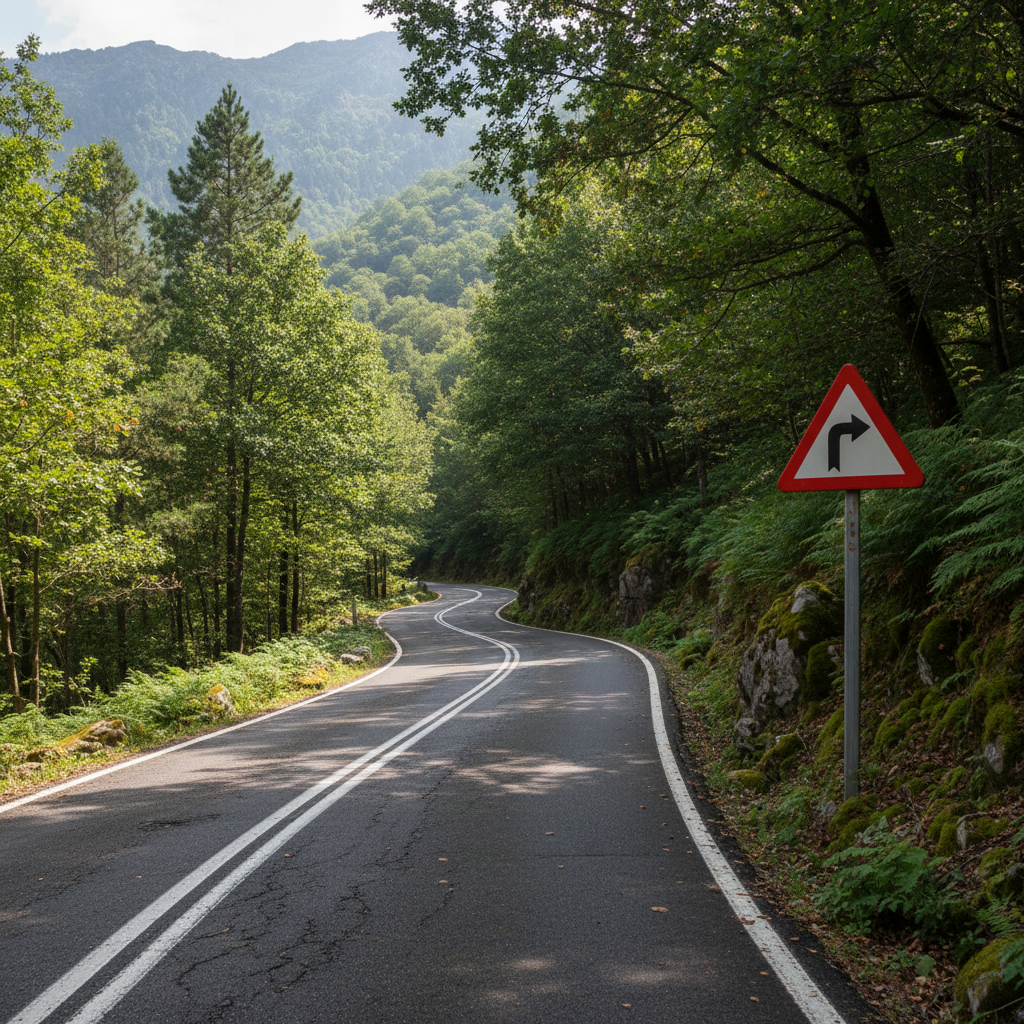
- Curve warnings come in multiple forms: single right/left curve, double curve (starting right or left), and series of curves. Each tells you the direction and severity of what is ahead
- Intersection warnings show the layout of the junction ahead, helping you anticipate traffic flow and priority rules
- The pedestrian crossing warning (triangle with pedestrian on zebra lines) means you should reduce speed and be prepared to yield to pedestrians
- The children warning sign (triangle with two children) is placed near schools and playgrounds and requires extra caution and reduced speed
- Roadworks warning (triangle with worker figure) indicates construction zones where temporary signs may override permanent ones
- The cattle/animal warning signs differ based on the type of animal (domestic livestock versus wild animals) and the appropriate response varies accordingly
Informational and Directional Signs
Informational signs are rectangular and provide guidance rather than orders. Their color coding is crucial for the exam. Blue rectangular signs indicate motorway information, including junction numbers, distances, and service areas. Green signs are used on conventional interurban roads for direction and distance information. White signs provide local urban information, points of interest, and facility indicators. Brown signs indicate tourist attractions and cultural sites. Understanding this color system helps you immediately identify what type of road you are on and what information the sign is providing.
Directional signs on Spanish motorways follow a specific format. The motorway identifier (such as AP-7 for the autopista or A-7 for the autovia) appears on the sign along with the destination name and distance. Junction signs include the junction number and the names of destinations accessible via that exit. Service area signs (marked with specific pictograms for fuel, food, accommodation, and other services) indicate the distance to the next service point. On conventional roads, kilometer markers provide location references, and distance signs show the distances to upcoming towns and cities.
Special Signs Unique to Spain
There are several signs that are specific to Spain or used differently than in other European countries. The Zona de Bajas Emisiones (Low Emission Zone) signs, increasingly common in major cities like Madrid and Barcelona, indicate areas where vehicle access is restricted based on environmental classification. The DGT environmental sticker system (Distintivo Ambiental) classifies vehicles into categories: Zero Emissions, ECO, C, and B. Vehicles without any sticker may be prohibited from entering certain areas. The environmental classification signs and their implications are becoming more frequent on the exam as Spain expands its low emission zones.
- Travesia signs mark the beginning and end of a road passing through an urban area, which changes the applicable speed limits and driving rules
- The blue parking zone (Zona Azul) sign indicates time-limited paid parking areas common in Spanish city centers
- Cambio de sentido signs indicate locations where U-turns or direction changes are permitted on divided highways
- The SOS post sign indicates the location of emergency phones on motorways, though these are becoming less common with widespread mobile phone coverage
- The Radar sign warns of fixed speed camera locations ahead, as Spain requires pre-warning of all fixed speed enforcement points
Traffic Lights and Signal Phases
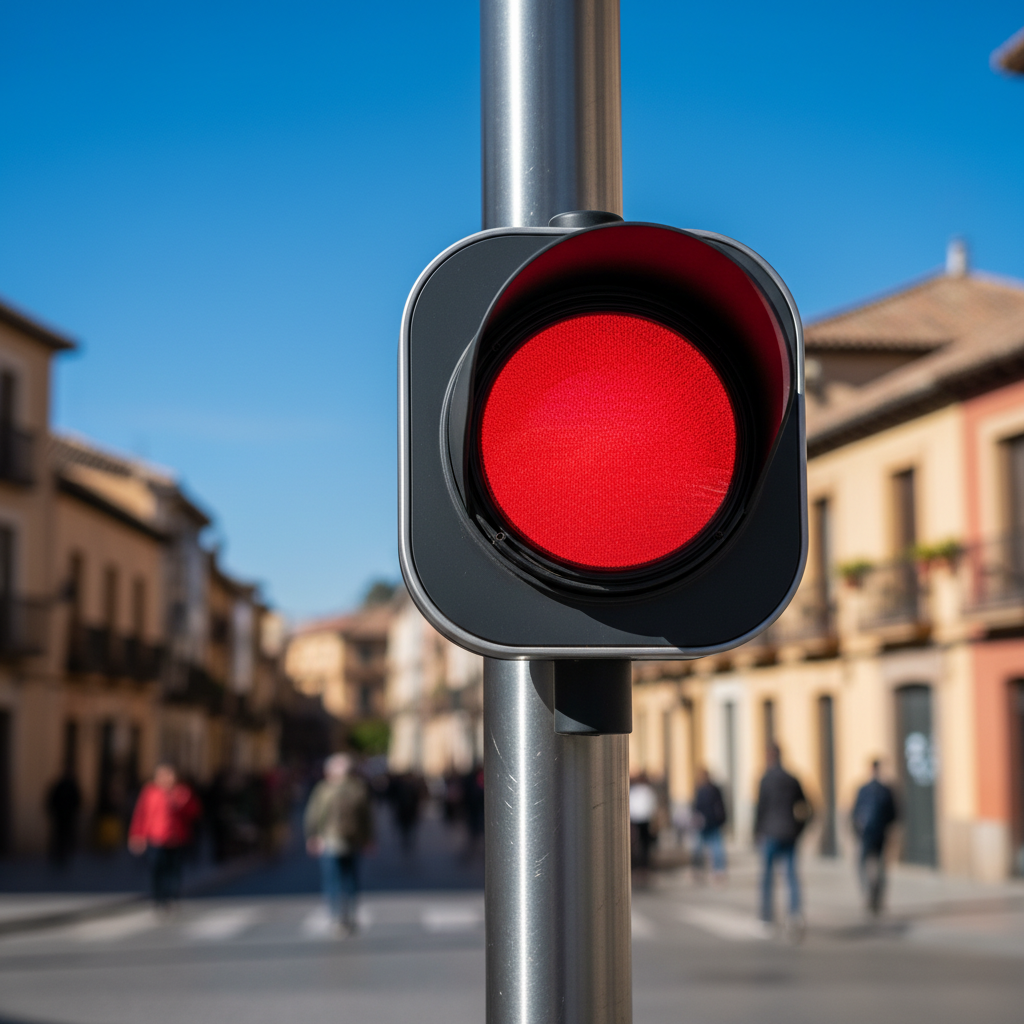
Spanish traffic lights follow the standard red-amber-green sequence, but there are several variations and specific rules that the DGT exam tests. A steady green light means you may proceed if the way is clear. A steady amber light means you must stop unless you are so close to the stop line that stopping would be dangerous. A steady red light means you must stop. Unlike in some countries, turning right on a red light is never permitted in Spain unless there is a specific green arrow signal allowing it.
Arrow signals are frequently tested on the exam. A green arrow allows movement only in the indicated direction. A red arrow prohibits movement in that direction even if other signals at the junction are green. Flashing amber lights have a specific meaning in Spain: they indicate that the traffic light is not regulating traffic normally, and you must proceed with caution while following the priority rules as if the traffic light were not there. This often confuses expats from countries where flashing amber has a different meaning.
Do not just memorize what each sign looks like. Understand the system. Circles give orders, triangles warn, rectangles inform. Red means prohibition, blue means obligation. Once you understand this framework, you can logically deduce the meaning of signs you have never seen before.
Road Markings: The Signs Painted on the Ground
Road markings are an extension of the traffic sign system and carry legal weight in Spain. The DGT exam includes many questions about road markings, and expats frequently lose points in this area because road marking conventions differ significantly between countries. The fundamental rule is that white markings are used to separate traffic flowing in the same direction or to mark the road edges, while markings separating opposing traffic flows can be continuous (no crossing permitted) or dashed (crossing permitted when safe).
- Continuous white line: You must not cross or straddle this line. It separates traffic in opposing directions or marks the edge of the carriageway
- Dashed white line: You may cross this line to overtake or change lanes when safe to do so
- Double continuous lines: Absolutely no crossing from either direction. This marking is used in areas with limited visibility or high danger
- Mixed lines (one continuous, one dashed): You may cross only from the dashed side. The continuous side is a hard boundary
- Zigzag lines: No stopping or parking. These are typically found near bus stops and pedestrian crossings
- Yellow lines along the kerb: No parking (single yellow) or no stopping (double yellow) depending on the area
- Shark teeth (inverted triangles painted on the road): Indicate a yield/give way obligation. You must give priority to traffic on the road you are joining
- Stop line with the word STOP: You must come to a complete stop at this line regardless of whether other traffic is visible

Temporary Signs and Roadworks
Temporary signs used during roadworks are another area where the DGT exam can catch you out. The key rule is that temporary signs always take precedence over permanent signs when they conflict. Temporary signs in Spain typically have a yellow or orange background, making them visually distinct from permanent signs. During roadworks, you may encounter temporary speed limits, lane closures, diversions, and changes to priority rules. The exam frequently presents scenarios where a temporary sign contradicts a permanent sign, and you must identify which one to follow. The answer is always the temporary sign.
Traffic officers directions take the highest priority of all, overriding both temporary and permanent signs, traffic lights, and road markings. This hierarchy of authority is a fundamental concept that appears in multiple exam questions. The full hierarchy from highest to lowest priority is: traffic officer signals, temporary traffic lights, temporary signs, permanent traffic lights, permanent vertical signs, and finally road markings. Understanding this hierarchy will help you answer any question about conflicting signals or instructions on the road.
Priority hierarchy for the exam: Traffic officer > Temporary lights > Temporary signs > Permanent lights > Permanent signs > Road markings. When any two of these conflict, the one higher in the hierarchy always takes precedence.
Practice Strategy for Sign Questions
To maximize your score on sign-related questions, focus on building a systematic understanding rather than attempting to memorize every sign individually. Start by learning the shape and color rules so you can immediately categorize any sign you see. Then study the most common signs within each category, paying special attention to the ones that differ from your home country. Finally, practice with image-based questions that present realistic road scenarios where you must identify the correct response based on the signs visible in the scene.
The SpanishDrivingTest.com platform includes a dedicated Signals and Traffic Lights section with targeted questions covering all the sign categories discussed in this guide. Working through these questions with the AI explanation feature enabled will help you understand not just what each sign means, but how it affects your driving decisions in practical scenarios. The voice-enabled coach can also quiz you on signs and provide real-time feedback on your understanding. Combine these tools with consistent daily practice, and you will be confident handling any sign question the DGT exam presents.