You have studied hard, passed the DGT theory test, and logged hours of practice behind the wheel. Now the practical driving exam stands between you and your Spanish driving licence. For English-speaking expats, this final stage can feel particularly daunting: the test is conducted entirely in Spanish, the marking system is strict, and the roads may be unfamiliar. This guide covers everything you need to know about the Spanish practical driving test, from what documents to bring on the day to exactly what the examiner is evaluating as you drive.
How the Practical Test Works in Spain
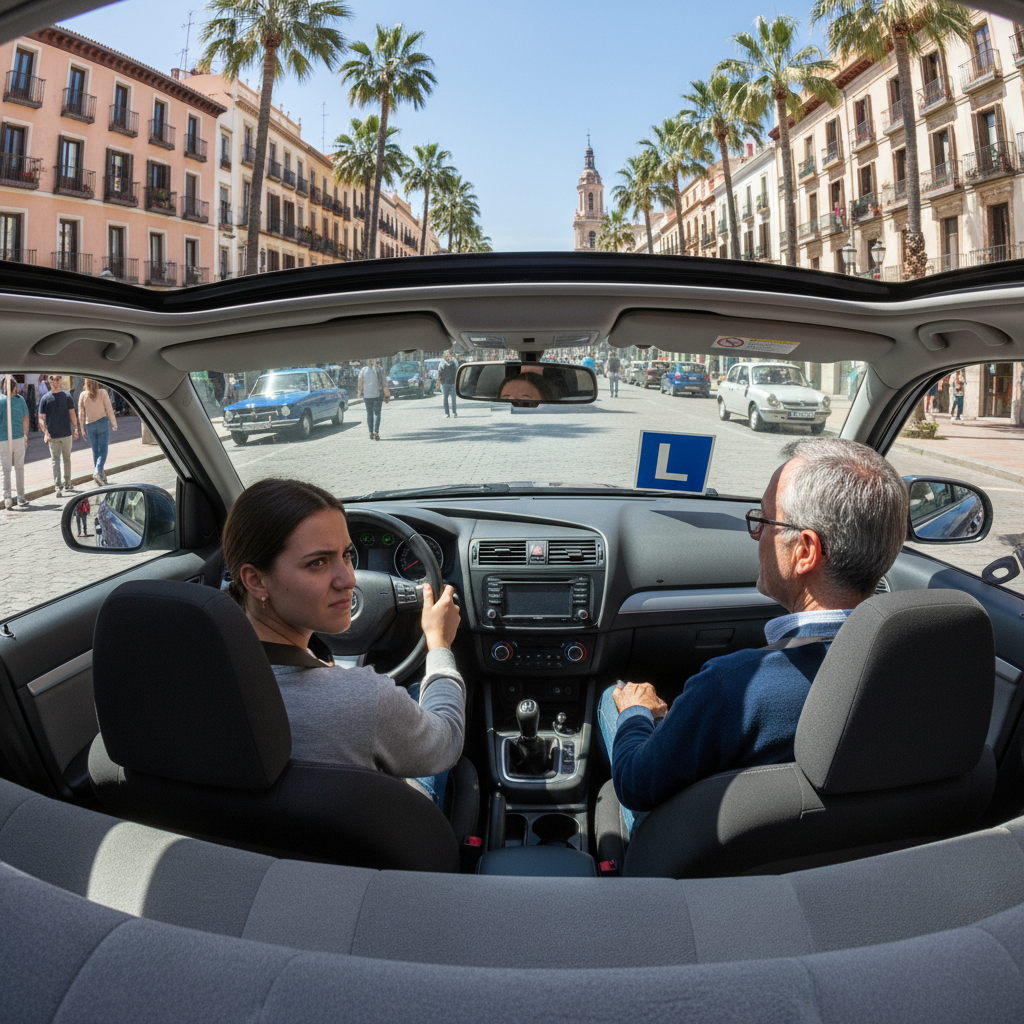
The Spanish practical driving test, officially known as the prueba de control de aptitudes y comportamientos en circulacion, is administered by the DGT (Direccion General de Trafico) through its network of regional examination centres. The test typically lasts around 30 minutes of active driving, though your overall time at the examination centre may be longer due to waiting and pre-test checks. Throughout the exam, you will be accompanied by a DGT examiner who sits in the rear seat of the vehicle behind you, observing your driving and recording marks on a standardised clipboard. Your driving instructor sits beside you in the front passenger seat for safety purposes only and cannot communicate with you during the test.
The vehicle used for the test is your autoescuela car, a dual-control vehicle equipped with a brake pedal and sometimes a clutch on the instructor side. The examiner will use this vehicle whether or not they instruct your instructor to intervene. You are responsible for all driving decisions throughout the test. The route is determined by the examiner and will vary, but all approved routes in your area are designed to cover a representative range of road types and traffic situations.
The practical test lasts approximately 30 minutes of driving. The examiner sits behind you and gives all instructions in Spanish. Your instructor is present for safety only and may not help you during the exam.
Prerequisites Before You Can Book the Practical Test
You cannot book the practical test until you have satisfied several requirements set by the DGT. The first and most fundamental is passing the theory test. There is no way to bypass this step, and your theory pass result is valid for two years. If you do not complete the practical test within that window, you will need to retake the theory exam. Beyond the theory test, you must have completed a minimum number of driving lessons with a registered autoescuela and obtained a medical certificate (certificado de aptitud psicofisica) from a DGT-approved medical examination centre, known as a centro de reconocimiento de conductores. This medical examination tests your vision, reaction times, and general fitness to drive and must be completed before you are officially registered as a driving candidate.
Your autoescuela handles the administrative side of booking the practical test on your behalf. They submit your documentation to the DGT, pay the examination fee, and confirm your test date and time. Test slots can be limited, particularly in major cities, so it is not unusual to wait several weeks between completing your lessons and sitting the exam. Use this waiting period wisely to continue practising and consolidating the skills you will need on test day.
What Documents to Bring on Test Day
Arriving at the examination centre without the correct documentation can result in your test being cancelled and your fee being forfeited. Make sure you bring the following items on the day of your exam.
- Your valid national identity document or passport, matching exactly the name on your DGT registration
- Your NIE (Numero de Identidad de Extranjero) if you are a non-Spanish national resident in Spain
- Your theory test pass certificate or the confirmation slip provided by your autoescuela
- Your medical certificate (certificado de aptitud psicofisica) issued by a recognised centre
- Any authorisation documents provided by your autoescuela confirming your exam registration
- Your residency card or documentation if applicable to your nationality and situation
Your autoescuela will usually remind you of these requirements in advance and may hold some of the paperwork on your behalf. However, it is always your responsibility to confirm what you need to bring. Contact your school a few days before the exam to double-check. Arriving early also gives you time to settle, review any last-minute notes, and speak briefly with your instructor before the examiner arrives.
The Exam Vehicle: Dual Controls and L Plates
You will take the practical test in the same car you have been training in at your autoescuela. This is intentional. The DGT requires candidates to use a vehicle provided by their registered driving school, and using a familiar car removes one source of uncertainty on an already stressful day. The vehicle will be a dual-control car, meaning the instructor has an independent brake pedal and, on manual vehicles, a duplicate clutch. These controls exist purely for emergency use by the instructor. The examiner does not have access to vehicle controls and relies on the instructor to intervene if a safety situation arises.
The car will display L plates (an L on a white square background) on the front and rear as required by Spanish law for learner vehicles. Before the test begins, the examiner will ask you to make a basic vehicle safety check. This typically involves confirming that the mirrors are correctly adjusted, that you know where the key controls are located, and that your seatbelt is fastened. Take this pre-drive check seriously. It is your first opportunity to demonstrate calm, methodical behaviour to the examiner.
The Examiner: What to Expect from Them
Your examiner is a DGT official, not a driving instructor. They are trained to evaluate driving performance against a standardised national framework and have no stake in whether you pass or fail. They will give you directions and instructions in Spanish throughout the test. There is no English option, no translator, and no exceptions to this rule. If you are concerned about managing Spanish instructions during the practical test, reading our dedicated guide on bridging the language gap between the English theory test and the Spanish practical exam is strongly recommended before your exam day.
The examiner will hold a clipboard with your marking sheet and will record observations throughout the drive. Do not be unsettled if you hear them writing. This is routine and does not necessarily indicate a fault has been recorded. Examiners are required to document observations regularly, including neutral notes about the route taken. They will not engage in conversation with you beyond giving instructions and, at the end of the test, communicating the result. Do not attempt to chat, ask questions mid-drive, or seek reassurance. Keep your focus entirely on the road.
The Route Structure: What Roads You Will Drive
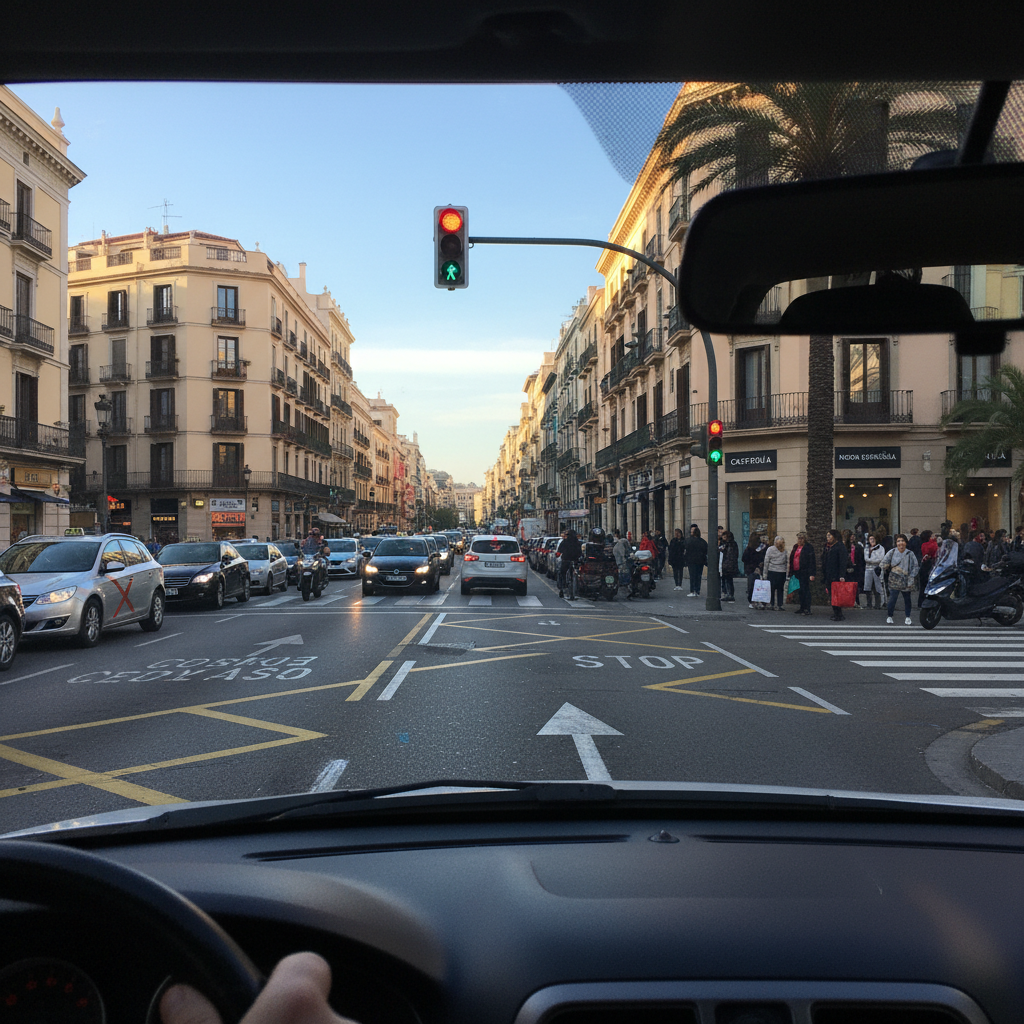
The examiner selects the route based on approved DGT circuits for your testing area. While you will not know the exact route in advance, the structure follows a consistent pattern. You can expect to drive through urban streets with traffic lights, pedestrian crossings, and junctions. The route will typically include sections of main road or a national road where higher speeds apply. Depending on your examination centre and its location, the route may also include a short section of motorway or dual carriageway, where you will need to demonstrate joining and leaving safely. The test will conclude with at least one parking manoeuvre and may include other compulsory exercises along the way.
One important advantage of enrolling with an autoescuela in your area is that experienced instructors know which routes the DGT uses locally. Your final lessons before the test will often involve practising on these exact roads. Familiarity with the specific junctions, roundabouts, and parking locations you are likely to encounter is a significant confidence booster and reduces the likelihood of being surprised by an unfamiliar situation during the exam.
Compulsory Manoeuvres You Must Be Ready For
Spanish DGT practical tests include specific manoeuvres that candidates must demonstrate competency in. These are not optional, and poor execution of a compulsory manoeuvre will result in faults being recorded. The exact manoeuvres included in your test will depend on the examiner and route, but the following are all commonly required.
Parallel Parking (Aparcar en linea)
You will be asked to parallel park between two reference markers or behind a parked vehicle. The examiner is looking for correct mirror checks, smooth reverse steering, and a final position that is close to the kerb without mounting it. You are allowed to make adjustments, but excessive shunting or mounting the pavement will be penalised. Practise this manoeuvre until you can execute it calmly and accurately in a single smooth sequence.
Hill Start (Arrancada en pendiente)
For manual vehicle candidates, the hill start is one of the most feared manoeuvres. You will be asked to stop on a hill, engage the handbrake, and then move off without rolling backwards. The key is coordinating the clutch bite point with handbrake release and throttle application. On automatic vehicles, this is considerably easier. Roll-back of more than 30 centimetres is typically recorded as a serious fault.
Emergency Stop (Frenada de emergencia)
At some point during the test, the examiner will instruct you to perform an emergency stop. They will say "frene bruscamente" or a similar command, and you must stop the vehicle as quickly as possible in a controlled manner. You should brake firmly and decisively, keep both hands on the wheel, and bring the car to a complete halt without losing control. On modern vehicles with ABS, you do not need to pump the brakes. Do not pre-empt this instruction; wait for it and then respond immediately.
Reversing and the Three-Point Turn (Cambio de sentido)
You may be asked to reverse in a straight line, reverse around a corner, or perform a three-point turn to change direction on a narrow road. Throughout any reversing manoeuvre, the examiner expects you to look over your shoulder and use your mirrors systematically. Relying solely on mirrors during reversing is a common fault. For the three-point turn, the examiner will evaluate your observation, your clutch control on a manual, and whether you complete the manoeuvre safely without mounting kerbs or requiring more than three movements.
The Marking System: Faults, Serious Faults, and Very Serious Faults
The DGT uses a three-tier fault classification system to assess your performance. Understanding this system removes much of the mystery around how results are decided and helps you prioritise what to focus on during preparation.
Faltas leves (minor faults) are small errors that individually do not fail the test. Examples include a slightly wide turn, a momentary delay in checking a mirror, or minor clutch roughness. However, accumulating too many minor faults in a single category can be upgraded to a more serious classification, so it is important not to repeat the same small mistake throughout the test.
Faltas graves (serious faults) will cause an immediate fail. These include failing to yield at a junction with priority, making an unsafe lane change, cutting across a pedestrian crossing when pedestrians are present, or performing a manoeuvre without adequate observation. A single serious fault ends the test with a fail result, even if the rest of your driving was excellent.
Faltas muy graves (very serious faults) represent the most dangerous category of error. These are severe breaches of road safety that would endanger you, your passengers, the examiner, or other road users. Very serious faults result in an immediate fail and are recorded separately on your result sheet. They carry greater weight if your examiner is required to provide a written report.
A single serious fault (falta grave) is enough to fail the test regardless of how well you drive for the rest of the 30 minutes. Focus on eliminating serious errors above all else.
Automatic Instant Fails: The Most Critical Mistakes
Certain actions will end your test immediately. These automatic fail scenarios are non-negotiable and no amount of otherwise excellent driving can compensate for them. The most common causes of immediate test termination include running a red light, failing to stop at a stop sign, exceeding the speed limit to a degree the examiner deems dangerous, performing a manoeuvre that forces another vehicle to brake or swerve to avoid a collision, and driving in a way that requires the examiner to instruct your instructor to physically intervene using the dual controls. If any of these situations occur, the examiner will instruct your instructor to end the test and return to the examination centre.
In addition, if you refuse to perform a required manoeuvre, become aggressive or uncooperative with the examiner, or demonstrate that you are unable to control the vehicle safely, the test will be terminated immediately. These situations are rare but worth knowing about. Stay calm, follow instructions, and remember that the examiner is there to evaluate, not to intimidate.
What the Examiner Is Actually Looking For
Beyond avoiding specific faults, the examiner is building an overall impression of whether you are a safe, independent driver. The key competencies they are evaluating fall into several distinct areas.
- Systematic observation: regular mirror checks before every manoeuvre, change of speed, or change of direction, plus over-the-shoulder blind spot checks when appropriate
- Signalling: using indicators correctly, in good time, and cancelling them promptly after completing a manoeuvre
- Speed management: driving at an appropriate speed for the road, conditions, and traffic, neither too fast nor unnecessarily slow
- Road positioning: keeping to the correct lane, positioning correctly for turns and roundabouts, and not straddling lane markings
- Smooth vehicle control: progressive braking and acceleration, smooth gear changes on manual vehicles, no jerky or abrupt inputs
- Hazard awareness: reacting calmly and appropriately to pedestrians, cyclists, parked vehicles, and other road users
- Following instructions: accurately and promptly responding to the examiners directions without hesitation or confusion
- Independence: driving confidently without relying on the examiner for prompting beyond standard instructions
Common Mistakes Expats Make on the Spanish Practical Test
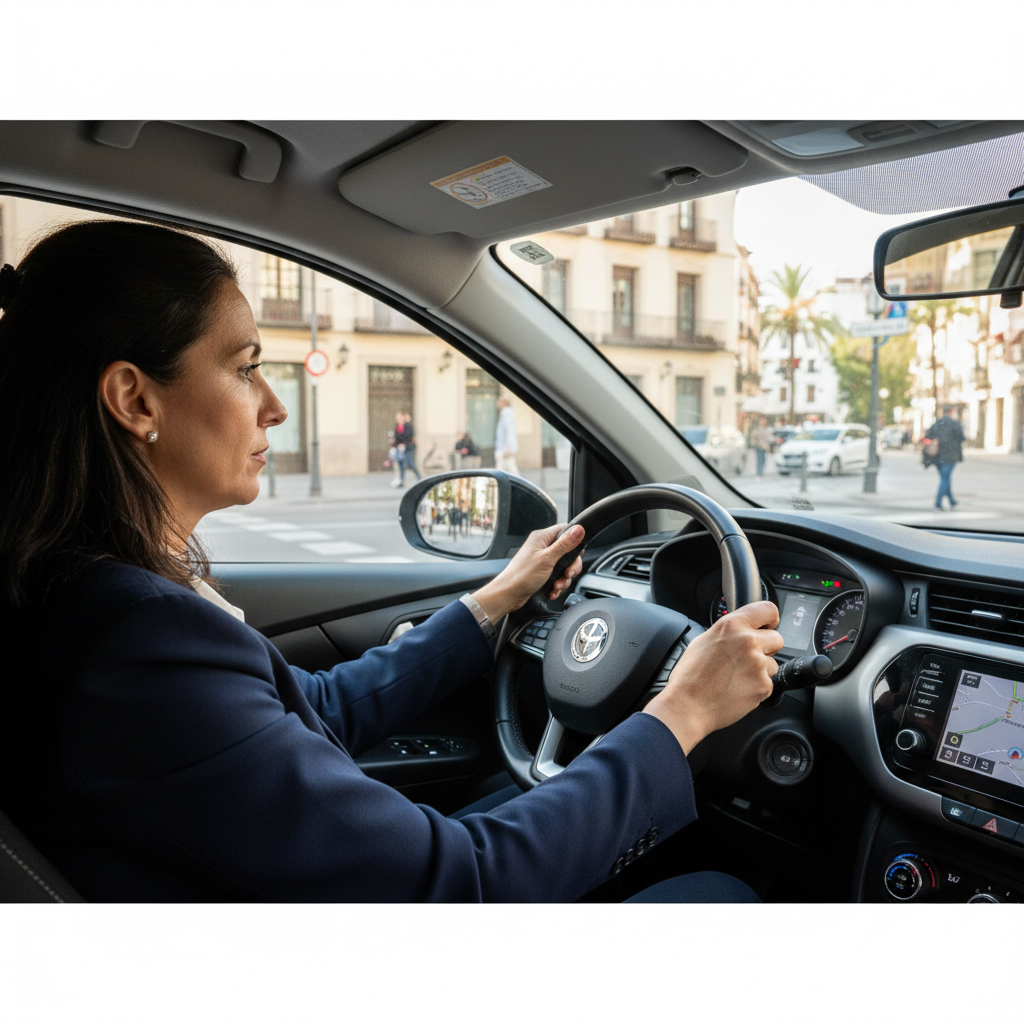
Driving instructors who regularly prepare English-speaking expats for the Spanish practical test report the same cluster of mistakes appearing repeatedly. Being aware of these patterns before your test gives you the opportunity to address them during your final lessons.
Insufficient mirror checks is the single most common reason for failing among expat candidates. Many drivers from the UK, Ireland, Australia, and other countries check mirrors out of habit but do so less frequently or less visibly than the DGT standard requires. In Spain, the examiner expects to see deliberate, clearly observable mirror checks before every change of speed or direction. Exaggerate your mirror movements so there is no doubt you are checking.
Hesitation at roundabouts is another recurring issue. Spanish roundabout etiquette differs from some other countries, and traffic in the roundabout always has priority over entering traffic. Many expat candidates either hesitate excessively when entering is clearly safe, or conversely enter too assertively when traffic is approaching. Study roundabout priority rules carefully and practise them until the decision of when to enter feels instinctive.
Speed errors occur in both directions. Some candidates, anxious to avoid speeding, drive significantly below the posted limit on roads where the limit would permit faster progress. This is not automatically a fault, but driving too slowly for the conditions can be recorded as a serious fault if it causes obstruction or signals a lack of confidence. Others, particularly on larger roads, allow their speed to creep above the limit without realising. Use your speedometer actively throughout the test.
- Not checking mirrors visibly and frequently enough before manoeuvres and lane changes
- Hesitating unnecessarily at roundabouts when entry is clearly safe, losing traffic flow
- Driving too slowly on main roads, which can be recorded as an obstruction fault
- Failing to cancel indicators promptly after completing a turn or lane change
- Not performing over-the-shoulder blind spot checks before moving off from stationary
- Mounting the kerb or swinging wide during parking manoeuvres
- Forgetting to set the handbrake when stopping on an incline
- Clutch slipping or stalling repeatedly during the hill start on manual vehicles
Managing Nerves on the Day of Your Test
Nerves before a driving test are universal. Even experienced drivers feel anxiety when being formally evaluated, and there is nothing wrong with feeling nervous. The key is managing that anxiety so it does not interfere with your driving. The most effective way to reduce test-day nerves is thorough preparation over the weeks leading up to the exam, rather than trying to apply relaxation techniques at the last minute. When you have genuinely done the work, nervousness transforms into a manageable level of healthy alertness rather than paralysing anxiety.
On the morning of your test, eat a normal meal and avoid excessive caffeine. Arrive early enough to use the toilet, speak briefly with your instructor, and complete a few breathing exercises if that helps you. In the car, before the examiner arrives, make any seat and mirror adjustments calmly and methodically. This pre-drive routine is something you should practise during your final lessons so it becomes a familiar, settling ritual. Once the test begins, focus entirely on the task in front of you. Do not think about the examiner, do not try to judge your performance mid-test, and do not let a single mistake spiral into anxiety about the rest of the drive. Each junction is independent. Each decision is new.
The candidates who pass are rarely the ones who drive perfectly. They are the ones who stay calm after a small mistake, keep their focus, and do not let one moment define the whole test.
After the Test: Result, Feedback, and What Comes Next
The result of your practical test is communicated to you immediately after you return to the examination centre and the examiner has completed their paperwork. You will be told whether you have passed or failed on the spot. If you pass, you will receive a provisional licence authorisation document that allows you to drive legally while your full licence is being processed by the DGT. Your physical licence card typically arrives within a few weeks by post. If you fail, you will be given your marked result sheet, which shows a breakdown of every fault recorded during the test, categorised by type and severity. This document is genuinely useful. Study it carefully with your instructor, because it tells you precisely where your driving fell short.
If you fail, you must wait a minimum period before retaking the test. In most cases this is at least one month, though the exact waiting period can depend on your examination centre and booking availability. Use this time productively. Rather than simply booking more hours in the car, work with your instructor to address the specific faults from your result sheet. A focused five lessons targeting identified weaknesses will serve you better than ten general lessons where those weaknesses are not directly addressed.
If you fail, your result sheet lists every fault recorded. Take this document to your next lesson and work through each item with your instructor. Targeted practice based on actual test feedback is far more effective than general revision.
Pass Rates for the Practical Test in Spain
The Spanish practical driving test has a notably lower pass rate than many expats expect, particularly those who have driven for years in other countries and consider themselves experienced drivers. National first-attempt pass rates for the practical exam in Spain typically hover between 55 and 65 percent, depending on the year and region. Some urban examination centres, particularly in Madrid and Barcelona, have even lower first-attempt pass rates due to the complexity of their traffic environments. This is not intended to discourage you; it is intended to set realistic expectations. Many experienced foreign drivers who underestimate the specificity of the DGT standard find themselves needing a second or third attempt.
For expats taking the test, the pass rate on first attempt is generally lower than the national average, primarily due to unfamiliarity with Spanish road conventions, the language barrier during instructions, and the difference in driving culture. However, expats who have completed a thorough preparation programme with an experienced autoescuela and who have specifically addressed the common mistakes outlined earlier in this guide perform significantly better. The test is passable; it simply requires the right kind of preparation.
Tips from Experienced Driving Instructors
We asked several driving instructors from autoescuelas across Spain who regularly work with English-speaking expats to share their most important pieces of advice for practical test candidates. Their insights reflect years of watching candidates succeed and fail and knowing exactly what makes the difference.
- Start mirror checking obsessively from your very first lesson and never stop. It should be the most automatic habit you have by test day.
- Learn the Spanish commands your examiner will use before you begin driving lessons so you can focus on driving from lesson one rather than language.
- Do not take the practical test until your instructor genuinely recommends you are ready. Booking too early to save money almost always costs more in retake fees.
- In the final two lessons before the test, ask your instructor to conduct a full mock exam on a realistic test route with no English and no help.
- On the day, if you hear a command you do not understand, say "puede repetir, por favor" (can you repeat, please). The examiner will repeat it without penalty.
- After a mistake, move on immediately. Dwelling on an error causes further errors. Each junction is a fresh start.
- Reduce speed smoothly and progressively when approaching hazards rather than braking sharply. Smooth driving is one of the clearest signals of a competent driver.
- Use the handbrake every time you stop for more than a few seconds. This is DGT standard practice and examiners notice when candidates skip it.
- Aim to pass in a manual car if you can. An automatic licence in Spain restricts you to automatics, which significantly limits your vehicle options as a resident.
Preparing as an English-Speaking Expat: A Final Word
The Spanish practical driving test is challenging by design. The DGT holds all candidates, regardless of nationality or prior driving experience, to the same rigorous standard. As an English-speaking expat, you bring valuable real-world driving experience to the test, but you also face specific hurdles that native Spanish candidates do not: the language of instruction, unfamiliarity with local road conventions, and in many cases, a very different previous driving culture. These are not insurmountable barriers. Thousands of expats pass the Spanish practical driving test every year.
The formula for success is straightforward, even if the execution requires real effort. Choose an autoescuela with experience teaching foreign residents. Learn the key Spanish commands early and practise them in every lesson. Address the specific weaknesses that are common among expat candidates before they become ingrained habits. Do not book the exam until your instructor confirms you are ready. And on the day, drive the way you have been trained, not the way you drove in your previous country. Spain has its own road culture, its own expectations, and its own standards. Meeting those standards is exactly what the practical test is designed to assess.
The practical test is not designed to trick you. It is designed to confirm that you can drive safely and independently on Spanish roads. Prepare thoroughly, know what to expect, and trust the training you have put in. That preparation, more than anything else, is what gets candidates through on test day.