Moving to Spain is an adventure that brings sunshine, incredible food, and a vibrant culture. But if you plan to drive on Spanish roads, you will need to navigate the bureaucracy of obtaining a Spanish driving license, known as the Permiso B. For many expats, the theory exam is the most daunting part of the process. The questions are specific to Spanish traffic law, the terminology can be unfamiliar, and the stakes feel high. The good news? With the right preparation, the theory test is absolutely conquerable. Thousands of international residents pass it every year, and you can too.
This guide is designed specifically for English-speaking expats living in Spain. Whether you have decades of driving experience from back home or you are starting from scratch, we will cover everything you need to know: how the exam works, what topics are tested, proven study strategies, common mistakes to avoid, and exactly what to expect on exam day. By the end of this article, you will have a clear roadmap for passing your Permiso B theory test on the first attempt.
What Is the Permiso B Exam?
The Permiso B is the standard driving license for passenger vehicles in Spain. It allows you to drive cars, vans up to 3,500 kg, and vehicles with up to nine passenger seats. The license is issued by the Direccion General de Trafico, known as the DGT, which is the government body responsible for all road traffic matters in Spain. To obtain your Permiso B, you must pass both a theory exam and a practical driving test. The theory exam must be passed first before you can schedule the practical portion.
- The exam consists of 30 multiple-choice questions drawn from the official DGT question bank
- You are allowed a maximum of 3 incorrect answers to pass (90% accuracy required)
- The time limit is 30 minutes, which gives you roughly one minute per question
- Questions are available in Spanish and several other languages including English
- You can take the exam at any DGT examination center, known as a Jefatura Provincial de Trafico
- There is an exam fee of approximately 95 euros, payable to the DGT via Tasa 4.2
- If you fail, you can retake the exam, but there may be a waiting period and additional fees
- Your theory approval is valid for two years, during which you must pass the practical test
- Most autoescuelas (driving schools) handle the registration process for you
- You will need your NIE or TIE, a medical certificate (certificado medico), passport photos, and proof of residency
Important: If you hold a valid driving license from an EU or EEA country, you may be able to exchange it directly for a Spanish license without taking any exams. Check with your local Jefatura de Trafico for the specific exchange agreements that apply to your country. Non-EU licenses from countries with bilateral agreements (like Switzerland or certain Latin American countries) may also qualify for direct exchange.
How the Spanish Driving Theory Exam Works
The theory exam is conducted at a DGT examination center. You will sit at a computer terminal and answer 30 questions, each with three possible answers. Only one answer is correct for each question. The questions are randomly selected from a large bank maintained by the DGT, which means no two exams are exactly the same. The questions cover a wide range of topics from traffic regulations and road safety to vehicle mechanics and first aid. Some questions include images showing road scenarios, traffic signs, or dashboard indicators that you must interpret correctly.
The pass threshold is strict: you can get no more than 3 questions wrong out of 30. That means you need to answer at least 27 correctly, which works out to a 90% pass rate. This is more demanding than many other European countries, where the pass mark is often around 70-80%. The high bar reflects the DGT approach to road safety education and is one reason why thorough preparation is so important. You have 30 minutes to complete the exam, which is generally plenty of time. Most people finish in 15 to 20 minutes.
The 7 Topic Areas You Need to Master
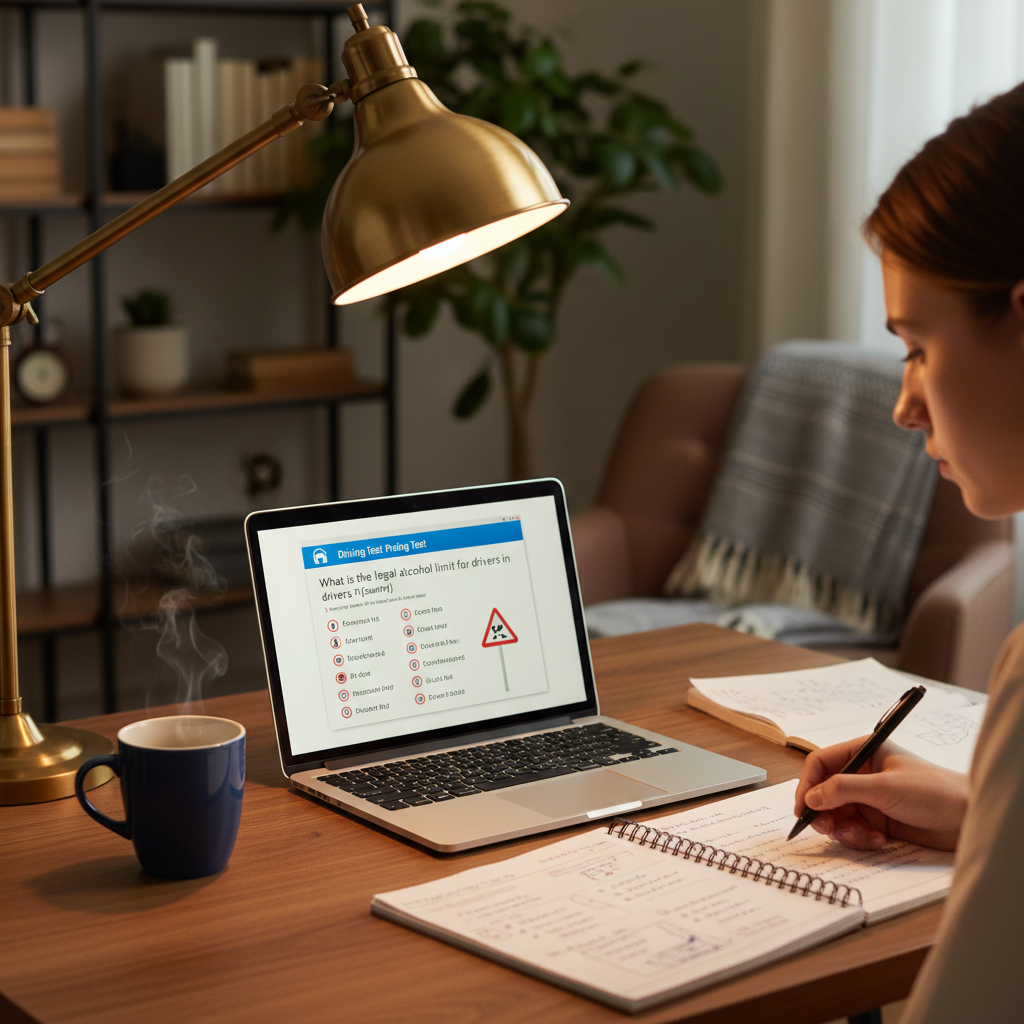
The DGT theory exam covers seven broad topic areas. Understanding what each section includes will help you organize your study time and ensure you are not neglecting any critical area. Here is a breakdown of each topic and what you can expect.
1. Definitions and General Rules
This section tests your knowledge of fundamental concepts in Spanish traffic law. You will need to understand the legal definitions of different road types including autopistas (motorways), autovias (dual carriageways), carreteras convencionales (conventional roads), and travesias (roads passing through urban areas). You should also know the classifications of different vehicles, the legal responsibilities of drivers, passengers, and pedestrians, and the authority hierarchy of traffic officers, signals, signs, and road markings. Many expats overlook this section because it seems basic, but the specific legal definitions in Spanish law often differ from what you might expect based on your home country.
2. Road Usage and Speed Limits
Speed limits in Spain vary based on the type of road, the type of vehicle, and weather conditions. For passenger cars, the standard limits are 120 km/h on autopistas and autovias, 90 km/h on conventional roads outside urban areas, and 50 km/h in urban areas (though some zones may be 30 or 20 km/h). This section also covers lane usage rules, safe following distances, overtaking regulations, and the specific rules for different road types. You need to know when overtaking is permitted and prohibited, how to use acceleration and deceleration lanes on motorways, and the rules for driving on roads with reversible lanes.
3. Maneuvers and Priority
Priority rules in Spain follow the general European pattern but have specific nuances you must understand. Vehicles on roundabouts generally have priority over those entering. At intersections without signs or signals, priority goes to the vehicle approaching from the right. Emergency vehicles with active lights and sirens always have priority. This section also covers the rules for turning, reversing, U-turns, parking, and stopping. You will need to understand the minimum distances for parking near intersections, pedestrian crossings, and bus stops, as well as the rules for double parking and loading zones.
4. Signals and Traffic Lights
Spain uses the standard European traffic sign system, but there are some signs unique to Spain or used differently than in other countries. You must recognize and understand regulatory signs (circular, which give orders), warning signs (triangular, which alert you to hazards), and informational signs (rectangular, which provide guidance). Special attention should be paid to signs indicating speed limits in specific zones, signs for restricted traffic areas in city centers (zonas de bajas emisiones), and the flashing amber signals used at some intersections. Traffic light sequences and the meaning of arrows, flashing lights, and lane-specific signals are also heavily tested.
5. Lighting and Visibility
This section covers when and how to use your vehicle lights correctly. In Spain, dipped headlights are mandatory in tunnels regardless of whether the tunnel is lit, on reversible lanes, on special lanes for slow vehicles (carriles adicionales), and in any conditions of reduced visibility. Full beam headlights must be used on poorly lit roads outside urban areas but must be switched to dipped when approaching or following another vehicle. Fog lights may only be used in conditions of severely reduced visibility such as fog, heavy rain, or snow. You also need to understand the rules for hazard warning lights, daytime running lights, and when the V-16 emergency light is required.
6. Safety and Documentation
Safety topics include seatbelt requirements for all occupants, child restraint system regulations based on height and age, the effects of alcohol and drugs on driving ability, and the legal blood alcohol limits. In Spain, the general BAC limit is 0.5 g/l (0.25 mg/l in breath), but for new drivers in their first two years and professional drivers, the limit is 0.3 g/l (0.15 mg/l in breath). Documentation requirements cover what you must carry in the vehicle at all times: your driving license, vehicle registration document (permiso de circulacion), technical inspection certificate (ITV), and proof of insurance. You should also carry the reflective safety vest and warning triangles or a V-16 emergency light.
7. Transport and Vehicle Mechanics
The final section covers basic vehicle mechanics, load securing, and transport rules. You need to understand the function of key vehicle systems including brakes, steering, suspension, tyres, and the engine cooling system. Tyre maintenance is a popular exam topic: you should know the minimum legal tread depth (1.6 mm), how to check tyre pressure, and the signs of uneven wear. Load securing rules specify how far cargo can extend beyond the vehicle and the required signaling for oversized loads. Basic first aid principles and the correct procedures at the scene of an accident are also covered, including when to call 112 and how to use the PAS protocol (Protect, Alert, Help).
The biggest mistake expats make is assuming their driving experience from home is enough. The Spanish exam tests knowledge of specific Spanish traffic law, not general driving ability. Study the rules as if you have never driven before.
Study Strategies That Actually Work
Passing the Permiso B theory exam requires a strategic approach to studying. Random reading of the DGT manual is not enough. You need targeted practice with real exam-style questions combined with a solid understanding of the underlying rules. Here are the strategies that consistently produce the best results for expats preparing for the exam.
- Start with the official topics and work through them systematically, one at a time, rather than jumping between subjects randomly
- Practice with exam-style multiple-choice questions daily. Aim for at least 30 questions per study session to build the stamina needed for the real exam
- When you get a question wrong, do not just memorize the correct answer. Read the explanation and understand the rule behind it so you can apply it to differently worded questions
- Focus extra time on your weakest areas. Track which topic sections give you the most trouble and dedicate additional study sessions to those specific sections
- Learn the Spanish terminology even if you plan to take the exam in English. Terms like travesia, arcen, and calzada appear frequently, and understanding them in context will help you answer questions faster
- Study the images and diagrams carefully. Many questions include visual scenarios where you must identify the correct action based on road markings, signs, and vehicle positions
- Take full 30-question practice exams under timed conditions at least twice a week. This builds your confidence and helps you manage the pressure of the real exam
- Use AI-powered tools to get explanations for questions you find confusing. Understanding the reasoning behind each answer is far more valuable than rote memorization

Common Pitfalls for English-Speaking Expats
After working with hundreds of English-speaking students preparing for the Permiso B exam, certain patterns of mistakes emerge repeatedly. Being aware of these common pitfalls can save you significant study time and prevent frustrating errors on exam day. The differences between Spanish traffic law and the rules in the UK, US, Australia, or other English-speaking countries are subtle but critical.
- Confusing autopista and autovia. Both are high-speed roads, but autopistas are toll roads while autovias are free. The speed limits are the same (120 km/h) but the access rules and service area provisions differ
- Assuming roundabout rules are the same as back home. In Spain, you are not legally required to signal when entering a roundabout, only when exiting. This surprises many UK and Australian drivers
- Underestimating the lighting rules. Spain requires dipped headlights in tunnels, on reversible lanes, and in reduced visibility. Many expats lose points on questions about when fog lights are permitted
- Not knowing the specific BAC limits for new drivers (0.3 g/l blood, 0.15 mg/l breath) versus experienced drivers (0.5 g/l blood, 0.25 mg/l breath)
- Forgetting that children under 135 cm must use an approved child restraint system and cannot travel in the front seat except in specific circumstances
- Ignoring the vehicle mechanics questions. Expats often focus only on traffic rules and are caught off guard by questions about tyre tread depth, brake systems, and engine warning lights
- Not understanding the penalty point system. Spain uses a merit-based system where new drivers start with 8 points and experienced drivers have 12. Points are deducted for infractions, and losing all points results in license revocation
Language tip: Even if you take the exam in English, some translations of DGT questions can be awkward or use unfamiliar British English terminology. If a question seems confusing, try to identify the underlying traffic rule being tested rather than getting caught up in the phrasing.
Exam Day: What to Expect
On the day of your theory exam, you will need to arrive at the DGT examination center at least 15 minutes before your scheduled time. Bring your original identification document (passport or NIE/TIE card) and the exam appointment confirmation from your autoescuela. You will not be allowed to bring phones, smart watches, or any electronic devices into the exam room. The center staff will verify your identity, assign you a computer terminal, and briefly explain the exam interface.
The exam interface is straightforward. Each question appears on screen with three answer options labeled A, B, and C. You select your answer by clicking on it. You can navigate forward and backward through the questions and change your answers at any time before submitting. There is a timer visible on screen showing your remaining time. Once you are satisfied with your answers, you submit the exam and receive your result almost immediately. If you pass, your autoescuela will be notified and can begin scheduling your practical driving lessons and test. If you do not pass, you can typically rebook within a few weeks.
How Online Practice Tests Help You Prepare
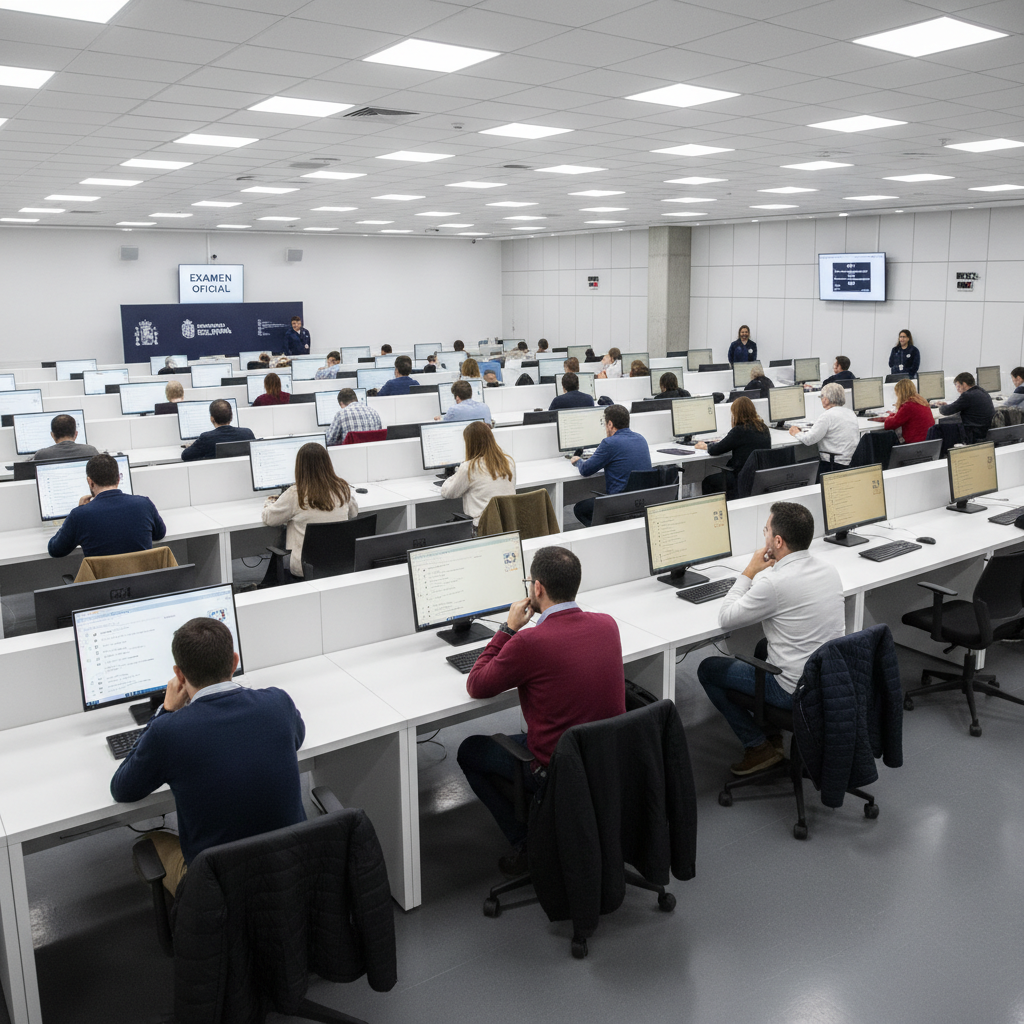
Online practice platforms like SpanishDrivingTest.com are specifically designed to replicate the format and difficulty of the real DGT exam. By practicing with questions that mirror the actual test, you build familiarity with the question style and develop the ability to quickly identify the correct answer under time pressure. The AI-powered explanations that accompany each question help you understand not just what the right answer is, but why it is correct, which is the key to handling questions you have never seen before.
The advantage of topic-based practice is that it allows you to identify and strengthen your weak areas before attempting full exam simulations. Start by working through each of the seven topic sections individually until you consistently score above 90%. Then switch to mixed practice exams that draw questions from all sections randomly, just like the real exam. This two-phase approach builds both depth of knowledge and the flexibility to handle any question combination the DGT throws at you.
Final Thoughts
The Spanish Permiso B theory exam is challenging, but it is far from impossible. With consistent study over two to four weeks, a focus on understanding the rules rather than memorizing answers, and regular practice with exam-style questions, you can absolutely pass on your first attempt. The key is to approach the exam with respect for the material and a structured study plan. Do not rely on your existing driving knowledge from another country. Treat the Spanish exam as a fresh learning experience and invest the time to understand how traffic law works specifically in Spain.
Remember that obtaining your Spanish driving license is not just about passing an exam. It is about becoming a safe, knowledgeable driver on Spanish roads. The rules you learn during your preparation will serve you every day behind the wheel, from navigating Barcelona rush hour traffic to cruising along the coastal roads of Andalucia. Take the preparation seriously, use the tools available to you, and you will be holding your Permiso B before you know it. Buena suerte, and see you on the road.