Alcohol is one of the single biggest contributors to fatal road accidents in Spain, and the DGT reflects this by making it one of the most thoroughly tested subjects in the Permiso B theory exam. Understanding alcohol limits is not just about passing a test — it is about grasping a legal framework that applies to you every time you get behind the wheel. For expats preparing for the Spanish driving exam in English, this topic can be particularly challenging because the limits are expressed in two different units simultaneously, and different rules apply to different categories of driver. This guide will take you through every rule, every limit, every penalty, and every exam-style question pattern so that nothing catches you off guard.
Spain's approach to drink-driving sits within the framework of European Union road safety directives, but the specific thresholds and penalties are set by national legislation — primarily the Ley de Tráfico, Circulación de Vehículos a Motor y Seguridad Vial and the associated Reglamento General de Conductores. The DGT updates its exam question bank regularly to reflect legislative changes, so it is important to study current figures. The information in this guide reflects the rules in force as of 2026.
The Two Ways Alcohol Is Measured in Spain
Before looking at the specific limits, it is essential to understand that Spanish law — and the DGT exam — expresses alcohol concentration in two different ways: blood alcohol content (BAC) measured in grams per litre of blood (g/l), and breath alcohol content measured in milligrams per litre of exhaled air (mg/l). Both measurements describe the same physiological state, just using different testing methods. A roadside breathalyser measures breath alcohol, while a blood test taken at a medical facility measures blood alcohol directly. The exam will use both units, and you need to be fluent in both.
- Blood alcohol content (BAC): measured in grams per litre of blood (g/l). A blood test is the most accurate method and is used when breath tests are disputed or when a driver is unconscious
- Breath alcohol content: measured in milligrams per litre of exhaled air (mg/l). This is what roadside breathalysers measure and is the most common enforcement tool
- Conversion: 0.5 g/l in blood is equivalent to 0.25 mg/l in breath. The ratio is 2:1 — the blood figure is always double the breath figure for the same alcohol level
- If you remember only one conversion rule, remember this: divide the blood limit by 2 to get the breath limit, or multiply the breath limit by 2 to get the blood limit
The DGT exam frequently presents a limit in one unit and asks you to identify the correct equivalent in the other unit. Always remember: 0.5 g/l blood = 0.25 mg/l breath, and 0.3 g/l blood = 0.15 mg/l breath. These conversions appear in exam questions more often than any other alcohol-related calculation.
The General Alcohol Limit for Most Drivers
The standard alcohol limit that applies to the majority of drivers in Spain is 0.5 grams per litre of blood, or 0.25 milligrams per litre of exhaled air. This limit applies to anyone who holds a full driving licence and is not in any of the special categories described below. It covers the vast majority of ordinary passenger car drivers who have held their licence for more than two years and are not driving professionally. This limit has been in place for many years and is the one most people associate with the phrase "drink-driving limit in Spain."
It is worth understanding what this limit means in practical terms, though the DGT is deliberately cautious about this. The actual effect of a given amount of alcohol varies significantly between individuals based on body weight, gender, metabolism, whether food has been consumed, hydration level, and individual tolerance. A single glass of wine might push one person above the limit while leaving another well below it. For this reason, the DGT's official guidance — and the correct answer to many exam questions — is that the only safe approach is to drink no alcohol at all before driving. The limit exists as a legal threshold, not a recommendation for how much you can safely consume.
Stricter Limits: New Drivers and Professional Drivers
Two categories of driver are subject to a lower alcohol limit than the general public: new drivers and professional drivers. For both groups, the limit is 0.3 grams per litre of blood, or 0.15 milligrams per litre of exhaled air. This is 40% lower than the standard limit, reflecting the additional responsibility these drivers carry and the heightened risk that alcohol poses in their specific situations.
New Drivers: The First Two Years
A driver is considered a "new driver" for the first two years after obtaining their licence. During this probationary period, the lower limit of 0.3 g/l blood (0.15 mg/l breath) applies. This period corresponds to the probationary phase of the Spanish points system, during which new drivers start with 8 points on their licence instead of the full 12 that experienced drivers hold, and must accumulate a clean driving record to reach the full 15 points available after three years. The rationale for the lower alcohol limit is straightforward: new drivers lack experience in handling the reduced reaction times and impaired judgement that alcohol causes, making them disproportionately dangerous when they combine drink with driving.
Professional Drivers
Professional drivers — those who drive for hire or reward, or who drive vehicles requiring a higher licence category — are also limited to 0.3 g/l blood (0.15 mg/l breath). This category includes taxi and rideshare drivers, bus and coach drivers, truck and lorry drivers, and anyone transporting passengers or goods commercially. The lower limit reflects the duty of care professional drivers owe to their passengers and to the public. A bus driver impaired by alcohol is not only risking their own life — they are responsible for dozens of other people. The exam frequently uses professional driving scenarios to test whether you know the lower limit applies.
Zero Tolerance in Practice: What the 0.3 g/l Limit Means for New Drivers
While the legal threshold for new drivers is 0.3 g/l, the DGT's practical advice — and the spirit of many exam questions — reflects a zero-tolerance approach. The reason is simple mathematics: 0.3 g/l is so close to zero that the only way to reliably stay below it is to drink nothing at all before driving. A single small beer or glass of wine can push many people above 0.3 g/l, depending on their individual metabolism. This creates a situation where new drivers cannot safely estimate whether they are within the legal limit after any alcohol consumption whatsoever. When exam questions ask about the recommended behaviour for a new driver who has had a small amount to drink, the correct answer is always to not drive, regardless of how little alcohol was consumed.
The exam also tests the duration of the lower limit. It applies for exactly two years from the date of licence issue, not two years from passing the theory test or from completing the practical exam. This is an important distinction. The two-year clock starts when the licence is officially granted by the DGT. During this entire period, any breath test result above 0.15 mg/l is a legal infraction, even if the same reading would be perfectly legal for an experienced driver.
How Random Breath Tests Work in Spain
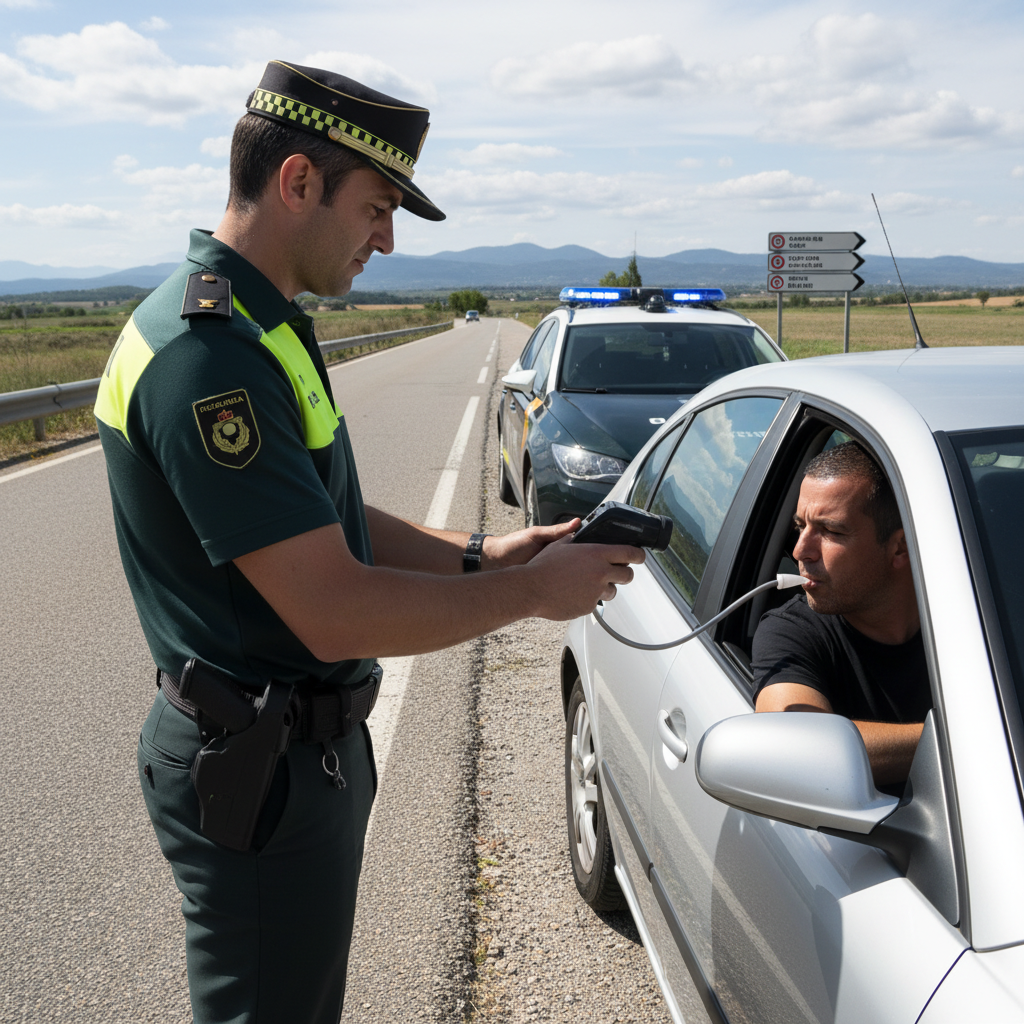
The Guardia Civil Tráfico and local police forces have the authority to stop any vehicle at any time and request a breath test, without needing any reason to suspect the driver has been drinking. These random checks are a routine and accepted part of driving in Spain, particularly during holiday periods, at weekends, and around events where alcohol consumption is likely. Mass testing operations are regularly conducted on major roads, where every vehicle passing through a checkpoint is stopped and tested. Understanding how this process works is important for the exam and for knowing your rights and obligations as a driver.
- The initial test uses an evidential breathalyser. The driver blows into the device for a sustained breath, and the reading is displayed immediately
- If the result is below the applicable limit, the driver is free to go. The test takes less than two minutes in most cases
- If the result is above the limit but below 0.60 g/l blood (the criminal threshold), the driver has the right to request a second test. The second test must be performed no less than 10 minutes after the first
- The lower of the two readings is taken as the official result — this is a legal protection for the driver, accounting for variations in the testing equipment
- If the driver disputes the breath test result, they have the right to request a blood test. This must be performed at an authorised medical facility. The blood test result is definitive
- Refusing to take a breath test is itself a criminal offence in Spain, regardless of whether the driver is actually over the limit. The exam specifically tests this point
- Results above 0.60 g/l blood (0.30 mg/l breath) trigger criminal proceedings, not just an administrative fine
Refusing a breath test is a criminal offence in Spain, punishable by up to six months in prison. This is a critical exam point — many candidates incorrectly believe they have the right to refuse. You do not. You must take the test if a police officer requests it.
Penalties for Drink Driving: Fines, Points, and Criminal Charges
Spain operates a dual-track system for alcohol-related driving offences. Below a certain threshold, offences are handled administratively — meaning they result in fines and points deductions but not criminal prosecution. Above the criminal threshold, or in cases of repeated offending, the matter enters the criminal justice system with far more serious consequences. The exam tests the exact thresholds and penalty levels, so memorising these figures is essential.
Administrative Penalties (Below Criminal Threshold)
- Exceeding the applicable limit (0.25 mg/l breath for standard drivers, 0.15 mg/l breath for new/professional drivers): Serious infraction. Fine of €500 minimum. Loss of 4 points from the driving licence
- Reading between 0.25 and 0.50 mg/l breath (standard driver): Serious infraction. Fine starting at €500. Loss of 4 points
- Reading between 0.50 and 0.60 mg/l breath: Very serious infraction. Fine of €1,000. Loss of 6 points. Possible suspension of driving licence
- Fines for alcohol offences cannot benefit from the standard 50% early payment reduction that applies to most other traffic fines
- Points deducted go against the driver's personal balance. A standard experienced driver starts with 12 points and can reach 15 points with a clean record. A new driver starts with 8 points
Criminal Penalties (Above 0.60 g/l Blood)
When a breath test result exceeds 0.60 g/l blood (0.30 mg/l breath), the offence crosses into criminal territory under Article 379 of the Spanish Penal Code. Criminal proceedings are handled by the courts, not the DGT, and the consequences are substantially more severe. A conviction for criminal drink-driving can result in a custodial sentence of three to six months (or community service or house arrest as alternatives), a fine calculated on the driver's daily income for a period of six to twelve months, disqualification from driving for one to four years, and a criminal record. These are not administrative penalties that can be paid off — they are criminal convictions with lasting consequences.
It is also important to note that even a reading below the criminal threshold can result in criminal charges if the driver causes an accident, if they are driving recklessly, or if they refuse the breath test. The criminal provision for reckless driving (conducción temeraria) can apply regardless of the alcohol level if the driver's behaviour demonstrates gross disregard for the safety of others. When combined with any alcohol in the system, the likelihood of criminal charges increases significantly.
How Alcohol Affects Your Ability to Drive
The DGT theory exam does not just test whether you know the legal limits — it tests whether you understand why those limits exist. Questions about the physiological effects of alcohol on driving ability are common, and they require you to understand how alcohol impairs the specific skills that driving demands. Alcohol is a central nervous system depressant, meaning it slows down the brain's processing of information. This affects driving in multiple, compounding ways that become increasingly dangerous as the blood alcohol level rises.
- Reaction time: Alcohol slows the speed at which the brain processes visual information and sends signals to the muscles. At 0.5 g/l, reaction time is measurably longer. At 0.8 g/l, it can be doubled. In a car travelling at 90 km/h, an extra second of reaction time adds 25 metres to your stopping distance
- Peripheral vision: Alcohol causes "tunnel vision" — a narrowing of the visual field that makes it harder to detect hazards at the sides of the road. Pedestrians stepping off the kerb and vehicles emerging from side streets are harder to see
- Depth perception and distance judgement: Alcohol impairs the ability to accurately judge how far away objects are, making overtaking and gap judgement particularly dangerous
- Coordination: Fine motor control deteriorates, affecting steering precision, smooth braking, and accurate use of controls
- Overconfidence: Counterintuitively, alcohol increases subjective confidence even as objective ability decreases. Drivers who are impaired often feel they are driving well, which makes them less likely to compensate for their reduced capability
- Fatigue interaction: Alcohol dramatically amplifies the effect of tiredness. A driver who is mildly tired and has had two drinks may be as impaired as someone who is severely sleep-deprived. The combination is particularly dangerous on long journeys
- Night vision: Alcohol impairs the eye's adaptation to darkness and increases sensitivity to glare from oncoming headlights, making night driving significantly more dangerous
The most dangerous aspect of alcohol is not the impairment it causes — it is the false confidence it creates. Impaired drivers consistently overestimate their own driving ability, which is precisely why they make the decision to drive when they should not. Understanding this is as important for the exam as knowing the legal limits.
Drug Driving: Zero Tolerance for Illegal Substances
While the alcohol rules allow for a small amount of alcohol before a legal infraction occurs, the rules for illegal drugs operate on a strict zero-tolerance basis. Under Spanish traffic law, any detectable presence of illegal substances — including cannabis, cocaine, amphetamines, opiates, and benzodiazepines obtained without a prescription — in a driver's system is a legal infraction. There is no minimum threshold. The law does not require evidence of impairment; the presence of the substance alone is sufficient for a prosecution.
Drug testing at the roadside is conducted using oral fluid tests (saliva swabs) that detect recent use of common substances. If a roadside test is positive, the driver can be required to undergo a laboratory analysis of blood or urine for confirmation. The penalties for drug driving are at least as severe as for drink driving, and the offence is treated as seriously by the courts. Prescription medications that affect driving ability — including some antihistamines, sleep aids, and painkillers — do not automatically constitute a drug driving offence, but drivers are expected to know whether their medication impairs their ability to drive and to act accordingly. The DGT exam may ask about the obligations of a driver who takes prescription medication that could affect driving.
Zero tolerance for illegal drugs means exactly that — zero. There is no safe or legal amount of cannabis, cocaine, or other illegal substances that you can have in your system while driving in Spain. Even if a drug was consumed several days earlier and you feel no impairment, a positive test result is a legal infraction. This appears regularly in the exam.
Common Misconceptions About Alcohol and Driving
The DGT exam frequently tests knowledge about common myths surrounding alcohol metabolism and sobering up. These questions are designed to identify whether candidates understand the science or are relying on folk wisdom that could get them into serious trouble. Here are the most important misconceptions, and the correct information you need to know for the exam and for your own safety.
- Coffee sobers you up: FALSE. Caffeine can reduce drowsiness temporarily, making you feel more alert, but it has no effect on your blood alcohol content. Your BAC falls only as your liver metabolises the alcohol, regardless of how much coffee you drink. An alert drunk driver is still a drunk driver
- Food slows absorption but does not lower BAC: PARTLY TRUE. Eating before or while drinking does slow the rate at which alcohol enters the bloodstream, which can reduce peak BAC levels. However, once alcohol is absorbed, food has no effect on metabolism. Eating after drinking does nothing to lower a BAC that is already elevated
- Cold water, exercise, or fresh air help: FALSE. None of these measures speed up alcohol metabolism or lower BAC. The liver processes alcohol at a fixed rate of approximately 0.1–0.15 g/l per hour, regardless of what you do
- Sleeping it off guarantees sobriety: PARTIALLY MISLEADING. Sleep does allow time to pass, during which the liver continues to metabolise alcohol. However, if you go to sleep at a high BAC, you may still be over the limit when you wake up several hours later — particularly if you wake early. Morning-after drink driving is a real phenomenon and a real risk
- "I feel fine" means I am fine: FALSE. Tolerance to alcohol means that regular drinkers may feel less impaired at a given BAC than occasional drinkers, but their actual driving performance is similarly degraded. Feeling fine is not evidence of being under the limit
- Breath mints or mouthwash fool the breathalyser: FALSE. Modern evidential breathalysers measure deep lung air, not mouth air. They are designed to be resistant to interference from breath fresheners, mouthwash, or hyperventilation
Common DGT Theory Exam Question Patterns on Alcohol
Having reviewed thousands of DGT theory exam questions on alcohol, there are distinct patterns in how this topic is tested. Recognising these patterns will help you approach unfamiliar questions with confidence. The following describes the most common question types and the reasoning the DGT expects you to apply.
Limit Identification Questions
These questions state a driver category (new driver, professional driver, or standard driver) and ask you to identify the correct limit, typically offering all three limits as options in one or both units of measurement. The answer pattern is: standard driver = 0.5 g/l blood / 0.25 mg/l breath; new and professional drivers = 0.3 g/l blood / 0.15 mg/l breath. Watch for questions that describe a driver who obtained their licence 18 months ago — they are in the new driver period. A driver who has held their licence for three years and drives a passenger car for personal use is a standard driver.
Unit Conversion Questions
These questions give you a limit in one unit and ask which option correctly states the same limit in the other unit. For example: "A driver has a blood alcohol content of 0.5 g/l. What is their breath alcohol content?" The answer is 0.25 mg/l. Or conversely: "The maximum breath alcohol limit for a professional driver is 0.15 mg/l. What is this in blood alcohol terms?" The answer is 0.3 g/l. The conversion is always a factor of 2 — blood in g/l is double the breath figure in mg/l.
Breath Test Procedure Questions
These questions describe a breath test scenario and ask about the correct procedure or the driver's rights and obligations. Key facts to remember: you cannot refuse a breath test; if your result is positive you can request a second test after 10 minutes; the lower of two results is used; you can challenge a breath test result by requesting a blood test; refusing a breath test is a criminal offence. A common question format: "A driver is stopped and asked to take a breath test. The driver has not been drinking. What should the driver do?" Answer: take the test, since refusing is illegal regardless of the actual alcohol level.
Effect on Driving Ability Questions
These questions ask about the specific effects of alcohol on driving performance. Common answer patterns: alcohol increases reaction time (making it longer/slower, not shorter); alcohol narrows the visual field; alcohol impairs depth perception; alcohol increases confidence while decreasing actual ability; alcohol amplifies the effect of fatigue; alcohol impairs coordination. When a question offers "alcohol reduces reaction time" as a potential correct answer, it is wrong — alcohol increases reaction time, meaning it takes longer to react.
What to Do If You Are Asked to Take a Breath Test
If you are driving in Spain and are stopped for a breath test — whether at a random checkpoint or because an officer has reason to suspect you have been drinking — knowing what to expect will help you remain calm and handle the situation correctly. The process is straightforward if you are sober. If you have been drinking, knowing your rights still matters.
- Pull over promptly and safely when signalled by police. Refusing to stop or driving away creates additional offences
- Switch off the engine and wind down the window. Be polite and cooperative — this is standard interaction with Guardia Civil Tráfico
- Present your driving licence and vehicle documentation if requested. Keep these accessible in your vehicle at all times
- When asked to take the breath test, blow firmly and steadily into the device for the duration the officer indicates. A valid breath sample requires a continuous blow of typically five to eight seconds
- If the result shows you are below the applicable limit, you will be informed and free to go. The officer must tell you the result
- If the result is positive, you have the right to be informed of the reading and the right to request a second test after at least 10 minutes. Exercise this right calmly
- If both tests show a positive result, you have the right to a blood test at a medical facility. If you exercise this right, you will be transported to or required to go to the facility
- Do not sign anything you do not understand. If you do not speak Spanish well, you have the right to an interpreter for any formal proceedings, though not necessarily at the roadside
- If you are detained following a positive test, you have the right to legal representation before making any formal statement
Alcohol Limits in Context: Why Spain Takes This So Seriously
Spain has made extraordinary progress in reducing road deaths over the past two decades. In 2000, more than 5,700 people died on Spanish roads. By the mid-2020s, that figure had fallen below 1,500 — a reduction of over 70% achieved through a combination of improved road infrastructure, better vehicle safety technology, stricter enforcement, and — crucially — changed cultural attitudes to drink driving. Alcohol was implicated in approximately 30–40% of fatal road accidents in Spain in the early 2000s. Sustained enforcement campaigns, the introduction of the points system in 2006, and progressive lowering of limits have brought that proportion down significantly, though alcohol remains a major factor in fatal crashes.
For expats coming from countries with higher legal limits — the United Kingdom has a limit of 0.8 g/l in England and Wales (0.5 g/l in Scotland), while the United States varies by state — the Spanish limits can initially feel strict. But the evidence from countries that have adopted lower limits is clear: fewer people die on roads where the limit is 0.5 g/l or below compared to countries with higher limits. The DGT's insistence on testing this topic thoroughly in the theory exam is not bureaucratic over-reach — it is a genuine effort to ensure that every driver on Spanish roads understands the rules that have contributed to saving thousands of lives.
Revision Summary: Key Numbers to Memorise
With multiple thresholds expressed in two different units, alcohol limits are one of the more number-heavy topics in the theory exam. Here is a consolidated summary of every figure you need to know. Spend time with these until they are automatic — the exam will test you on them directly, and getting the numbers wrong is one of the most avoidable mistakes you can make.
- Standard drivers (licence held for more than 2 years, non-professional): 0.5 g/l blood / 0.25 mg/l breath
- New drivers (first 2 years of licence): 0.3 g/l blood / 0.15 mg/l breath
- Professional drivers (taxis, buses, trucks, commercial vehicles): 0.3 g/l blood / 0.15 mg/l breath
- Illegal drugs: zero tolerance — any detectable presence is an offence
- Administrative / criminal threshold: 0.60 g/l blood / 0.30 mg/l breath. Above this = criminal offence, not just a fine
- Administrative fine for exceeding the limit: minimum €500
- Points deducted for exceeding the limit: 4 points (serious infraction) or 6 points (very serious infraction at higher levels)
- Second breath test: may be requested after a minimum of 10 minutes. The lower result is taken as official
- Refusal to take a breath test: criminal offence. No exceptions
- Conversion factor: blood alcohol (g/l) = 2 x breath alcohol (mg/l)
On the SpanishDrivingTest.com practice platform, the Alcohol and Drugs section in the Road Safety category contains questions directly drawn from the DGT official question bank. Work through all of these questions at least twice, paying particular attention to the unit conversion questions and the breath test procedure questions — these are the ones most commonly answered incorrectly by first-time candidates.
Understanding alcohol limits in Spain is not a one-and-done revision task. Come back to this topic a few days before your exam and run through the key numbers again. In the pressure of the exam environment, precise figures are easier to confuse than you might expect. The difference between 0.25 and 0.15, or between 0.5 and 0.3, can mean the difference between a correct and incorrect answer — and with only three questions allowed wrong on the standard theory exam, every question counts. Treat this topic with the thoroughness it deserves, and you will be well prepared for whatever the DGT throws at you.